

Sign up for TPR Today, Texas Public Radio's newsletter that brings our top stories to your inbox each morning.
For children with disabilities, accessible equipment can be difficult to acquire and use.
Some kids may need to wait until they are older and can use equipment such as wheelchairs. Adaptive equipment helps children gain mobility and independence, but it can be expensive.
Texas Military Institute Episcopal (TMI) student Gracie Martinez is making an impact in her community with a kid-friendly wheelchair she built using 3D-printing technology.
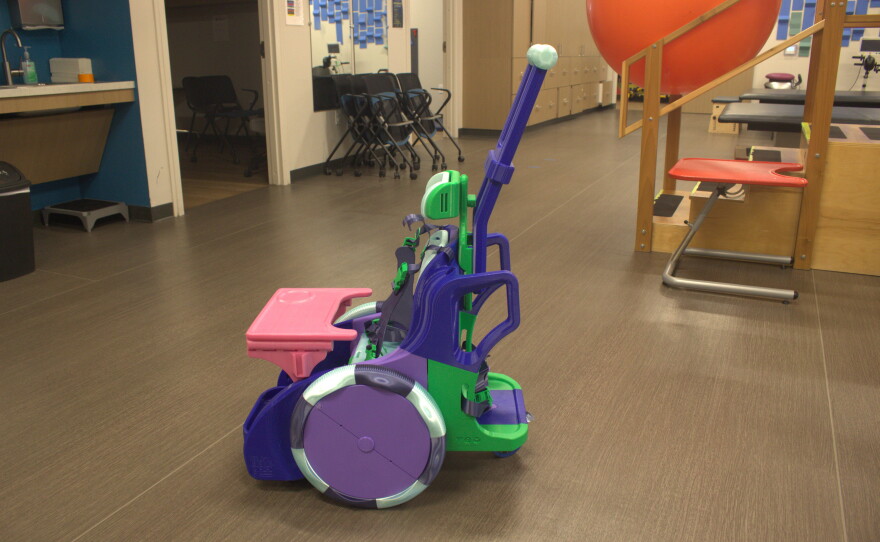
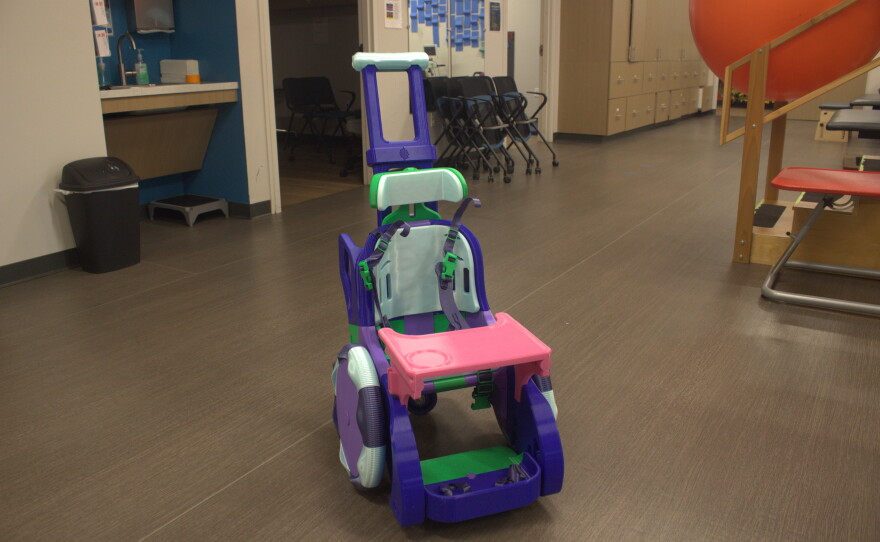
The Toddler Mobility Trainer (TMT) helps children learn to operate a wheelchair before they graduate on to a larger one.
The spark of the TMT idea came after Martinez and her mother saw an Instagram account from MakeGood, a New Orleans-based nonprofit organization that customizes free 3D-assistive devices for people with disabilities worldwide.
Martinez met with her teacher, Omar Valdez, to discuss the possibility of building her own 3D wheelchair.
"I asked him, 'Would this be possible to do?' And he was like, 'Yeah, for sure! TEAMability is actually looking for something similar to this,'" said Martinez.
TEAMability is an organization that supports individuals with complex disabilities using physical, occupational, and speech therapy. It is housed at Morgan's Multi-Assistance Center (MAC).
Valdez, director of innovation and design at TMI, is working with Martinez on using 3D printers to create accessible equipment for TEAMability's therapy patients.
Valdez said he wanted to support Martinez with her own lab of equipment to see the idea through.
"And so, she said, 'Mr. Valdez, do you think we could do it?' and I was like, 'Absolutely, let's see what we can do. Let's possibly get you some 3D printers that you could put in your house so that way you'd have your own laboratory that you could use, and you don't have to come back and forth from the school,'" said Valdez. "So, she set off, and she started 3D printing all of these different files."
Martinez downloaded 3D files from MakeGood's website. She printed out 18 individual pieces of the Toddler Mobility Trainer.
"I loved making it because it was like a big puzzle with all the pieces you can make," said Martinez. "I got to give it to somebody who really enjoyed it, and it was nice to see that, because seeing somebody that really needed something that can't usually be given ... because of the price, and being able to make it at a really low cost and just donating it was great."
Valdez says the chairs are also customizable.
"We have the ability to change the colors. To my knowledge, I haven't seen too many wheelchairs. ... I think I've seen maybe a pink one, especially for younger children," said Valdez. "But now with just a few pushes of a button, we can print a Ninja Turtle wheelchair or a princess wheelchair."
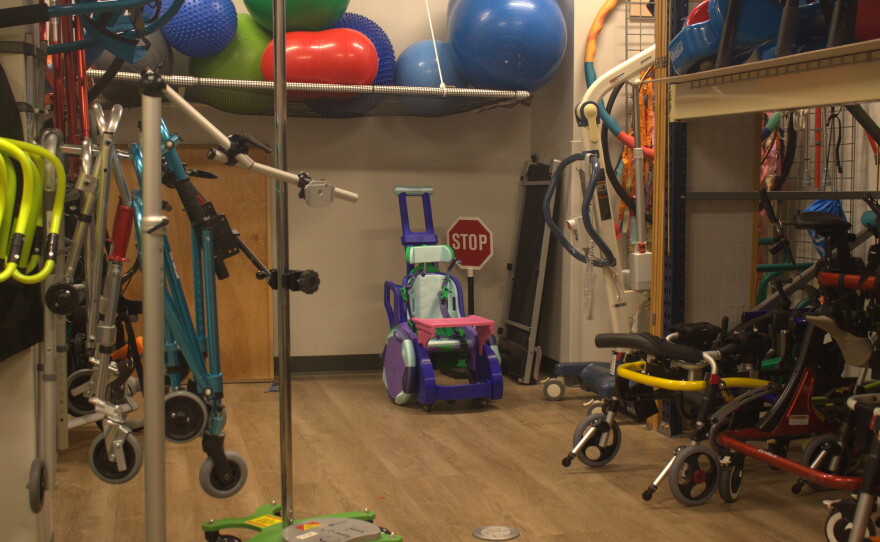
Martinez's 3D-printed wheelchair is now at TEAMability.
The TMT is a small, colorful chair with removable pieces, which can be interchanged with different colored parts. TEAMability CEO Brooke Kearney demonstrated how the wheelchair is printed.

"So, this is our 3D wheelchair. If you'll notice, all of the colored components that are different are modular. Gracie with TMI printed this for us, printed each of these (pieces) independently," said Kearney.
"So, what's really cool is in developing areas, rural areas, anybody — you or I — could purchase a 3D printer, print these parts, and then put the pieces together, which makes it really easy to ship and move."
And the textures are much more pleasant to the touch.
"So, notice how that feels different then touch(ing) the plastic here on this blue handle," said Kearney. "Notice how this is much harder, right? So, these are different types of plastic that come in a filament. ... You'll see here on the chair this color that you're holding — this is all kind of squishy."
Kearney said TEAMability's partnership with TMI made her see the endless potential of 3D printing.
"So, we can even make cushions and seats that are replaceable, different thicknesses, which kind of blew my mind."
Kearney said 3D printing allows TEAMability to create various adaptive devices.
"We had these straps, and I thought, 'Oh well, they just bought these straps.' No, they 3D printed (them). We can change the foot plates. Your imagination could go wild. You could make it any color, anything," said Kearney. "And because the printing plans are open, people constantly are creating new things, so they've got iPad holders, cup holders, all types of different adaptive devices, different types of handles. … It's showing the collaborative nature of this generation."
Martinez's project inspired TEAMability to 3D print additional equipment for the organization's patients.
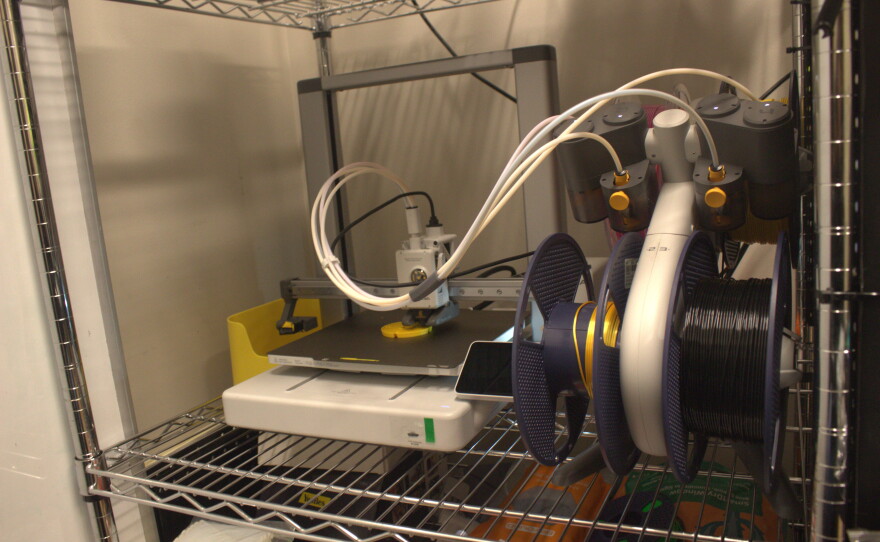
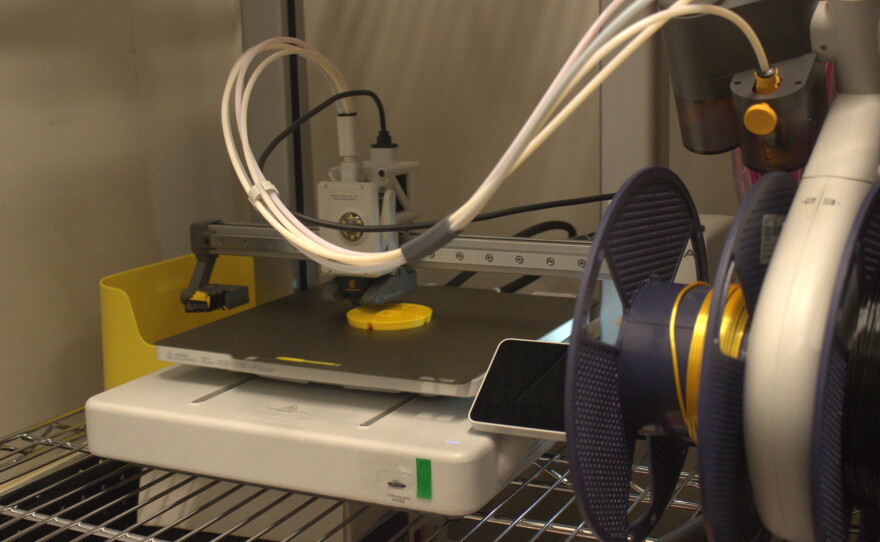
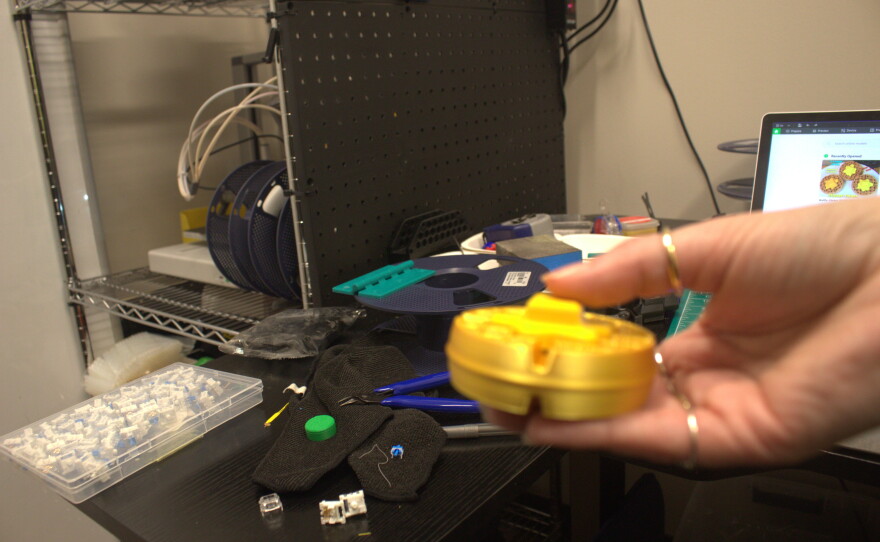
"I'm currently making a waffle fidget for one of my therapists that needs a fidget toy, but I think fidgets are good for all the kids or for all the therapists, just to keep them entertained," said Victor Gardea, TEAMability's clinical specialist.
Cecilia Najera, a professor in the Department of Occupational Therapy at UT Health San Antonio, said she has a student who is already utilizing TMI's 3D printers to create an adaptable bird feeder for one of their patients, a 79-year-old woman who injured her rotator cuff.

"And she's unable to lift more than 50 pounds, and she can't lift her arm higher than 60 degrees. ... That really is impacting her ability to care for birds and hummingbirds in her backyard, which is one of her most meaningful activities," said Najera.
"So, what this student designed was a bird feeder with an adaptive latch that allows her to just open the bird feeder with one hand. And I understand that Omar and the TMI team have already printed it. We're pretty excited about it," she said.
Najera said thanks to TMI, her students are exploring other 3D-printing opportunities.
"One of our students went to the movie theater to look at the wheelchair accessibility. And what they noticed was that while companion seats have trays for the food, for popcorn (and) drinks, the wheelchair sections did not have that. And so they're also working with TMI to construct an adaptable tray that could be used by wheelchair users in the movie, so that they can participate just like everyone else — have their popcorn beside them and have their drinks beside them," said Najera.
Martinez wants to take what she's learned and expand upon it once she finishes her studies.

"So, for college, I want to go study industrial engineering, so then that way I can (expand) from 3D to actual real world — like making buildings, making different stuff," said Martinez.
"Because working at TEAMability, I got to meet some people, and they were telling me that even though they say that the world is accessible, it really isn't. Like, they couldn't go to the bathroom without assistance. They can't go into a building without it being like a certain size or accommodating to other people. Like, seeing it through y'all's perspective, okay, I see now. This is a change that needs to be made," she said.
And that change can be both low-cost and pink, with interchangeable parts.
Copyright 2026 Texas Public Radio