

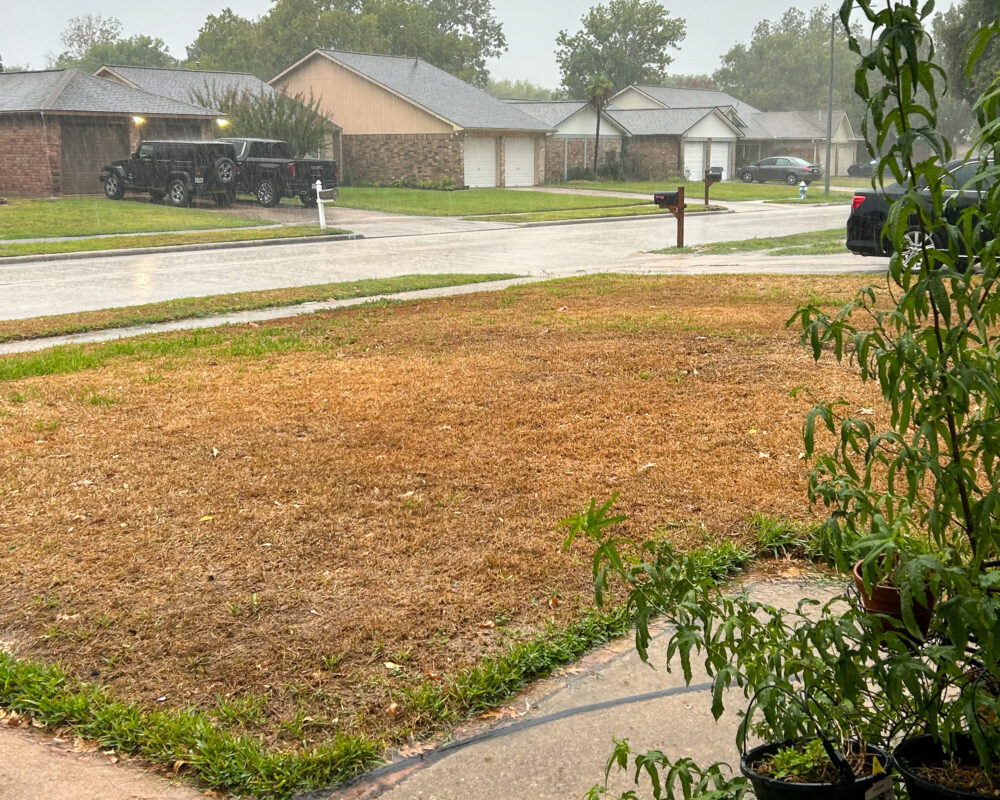
All of Harris County and most of Texas is in a moderate drought, according to the U.S. Drought Monitor's most recent data.
The U.S. Drought Monitor releases a national drought map every week, ranking the drought intensity of every county on a scale from "none" to "exceptional drought." According to the most recent map, which was published April 2 and includes data through March 31, all of Harris County is experiencing a "moderate drought," the second-lowest level of intensity.
Last weekend, the Houston area saw isolated thunderstorms, with 1.35 inches of rain falling Saturday at Hobby Airport, according to the National Weather Service’s Houston/Galveston office. But a meteorologist with the weather service said that wasn’t enough rainfall to make a difference in drought conditions.
NWS meteorologist Andy McNeel said similar storms are in the Houston region’s forecast for later this week.
"We're expecting to get some additional rainfall, and chances will peak for us on Friday," McNeel said. "We'll start with about 20%-30% chances going into Thursday and then those chances will increase going Thursday night into Friday night."
Harris County, which includes Houston, is not alone in facing drought conditions as all but about 1% of Texas is considered abnormally dry. Nearly 89% of the state is in at least a moderate drought, according to the U.S. Drought Monitor.

This year's mostly dry and warm winter was one of the contributing factors for the drought conditions across Texas, according to Texas State Climatologist John Nielsen-Gammon.
"The precipitation, statewide, generally has been running below normal for the past several months, although we're off to a pretty good start in April, so maybe the situation will start turning around," Nielsen-Gammon said. "The rain we've had so far has just basically paused the degradation rather than producing any widespread improvement."
While the temperature doesn't directly affect rainfall, Nielsen-Gammon said higher-than-normal winter temperatures allow plants to bloom earlier, leading to a natural increase in water usage, and cause what rain does fall to evaporate more quickly.
RELATED: Houston-area winter temperatures are trending warmer, despite recent cold snaps
"It's led to an earlier-than-normal emergence of leaves and plant growth this spring, which makes things actually a bit greener than normal right now," he said. "But, if we don't continue to get rain this month, that greenness will help deplete soil moisture and could potentially have impacts on drought later on this summer."
Drought conditions can have wide-ranging impacts on the environment and local economies across the state.
One such instance is how drought conditions have exacerbated the ongoing water crisis in Corpus Christi, which is facing the prospect of running out of water due to a combination of issues.
All of Nueces County, where Corpus Christi is located, is considered to be in at least a severe drought, while over 50% of the county is in extreme drought, according to the U.S. Drought Monitor.
Nielsen-Gammon said it would take an unnatural amount of rainfall to fill up the reservoirs used by Corpus Christi and South Texas communities.
"The most serious drought conditions are in South Texas, and part of that has been drought that's been going on for several years," he said. "So, realistically, to do something like fill up the reservoirs that Corpus Christi depends upon, we would need 20 or more inches of rain in fairly short order, or moderate above normal rainfall for a much longer period of time."
While climate change has contributed to an increase in unpredictable rainfall in Texas, Nielsen-Gammon said longer-term trends are hard to pin down.
"With rainfall being more erratic due to climate change and higher temperatures, that means you've got an increased chance of having an extended dry spell," he said. "So it can potentially get more frequent droughts because of that, although it's unlikely we'd be able to detect that sort of effect for quite some time."
As Texas continues to grow and its population rises, Nielsen-Gammon said Texas as a whole likely won't run out of water any time soon. But conservation efforts will likely have to be taken, he said.
RELATED: Recent report shows data centers may negatively impact Texas’ water supply
"There are other parts of the country that use much less water per person than we do," he said. "We have the capacity to cut back on water use that involves less pure green lawns and less water-intensive landscaping and things like that. So, I don't think we're ever going to get to the point of literally running out of water unless we don't manage cutbacks in water use successfully."
Copyright 2026 Houston Public Media News 88.7