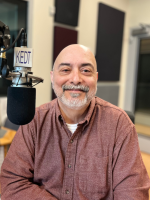
This interview originally aired on 2/12/2026 during KEDT-FM's South Texas Midday.
LON GONZALEZ: Good afternoon, everyone. Lon Gonzalez with you; and on the line, Mark Betancourt, who, in collaboration with another reporter, has released something very, very interesting about some orders going on through the Trump Administration: sending pregnant unaccompanied minors apprehended by immigration enforcement to a shelter in South Texas – San Benito, Texas, in the Rio Grande Valley, to be more precise. Mark, how are you doing today?
MARK BETANCOURT: I'm good. How are you, Lon?
LON GONZALEZ: I'm wonderful. Listen. This particular story is very involved. First of all, how did you come across a lot of this information and getting to where we are now?
MARK BETANCOURT: Well, this was information that was shared with me by several sources. It spoke to seven different people within the Office of Refugee Resettlement (ORR), which is an office within the Department of Health and Human Services in the federal government that handles the custody and care of unaccompanied migrant minors. So basically, when children get picked up by immigration authorities, if they're not with a parent or legal guardian, they go to ORR custody; and they get, usually placed in shelters or foster homes around the country. And people within the office brought to my attention the fact that last July, the government actually ordered ORR, this office that handles unaccompanied kids to send all of the pregnant kids, which means basically anyone in ORR care who was pregnant, the children could be very young, up through 17 years old. Anyone who was pregnant had to be sent to this one shelter in South Texas. And that immediately caught my attention, because I knew that was against the sort of usual flow of how things go on at ORR; and that was about six months ago, and we just sort of put our noses to the grindstone to try to figure out what was going on.
LON GONZALEZ: Why this particular shelter in South Texas?
MARK BETANCOURT: Well, that was the question. It was really unclear, why they would concentrate all these girls anywhere – let alone at one place in Texas – where the main concern that was being passed on to me from people within ORR was basically that there's not a lot of health care. As a lot of your listeners will know, if it's not a health care desert in some of those places, that certainly the specialized health care is very limited there, so care can be delayed or not available at all, and that's really important, because these girls have what a lot of doctors told my reporting partner, Mose Buchele and I, are 'high risk pregnancies.' The younger a child is who is pregnant, the more likely it is that they'll have complications. A lot of times, they can give birth too early because of their size, which can be really dangerous for both the mother and the baby. Some of these girls are so young that they're still growing, and their pelvises aren't actually wide enough to safely give birth, so they basically, almost that by definition, need specialized health care that is very limited in this area. So that was one of the main concerns that came with placing these girls at this shelter. The shelter itself has actually, as recently as 2024, was barred from receiving pregnant girls for a little while because they were not providing proper medical care there.
LON GONZALEZ: I see, knowing a little bit about that region, I know that literally, a half hour west of San Benito, you've got the city of McAllen, which has multiple medical facilities who could probably help these girls. Is there not a shelter in that part of the Rio Grande Valley?
MARK BETANCOURT: There are several shelters there. It's not clear really, what exactly the reason for that is, why they were placed at this particular place. But the problem is that not only is there not that much specialized care in terms of what they call maternal fetal medicine specialists, there just aren't that many of those people. So you know, if there aren't that many of them, that means they've got more patients that need to take longer to see them. So there's sort of this ripple effect in general. But also you've got to remember that because of the almost total abortion ban in Texas. Just placing these girls in Texas means that if there are any medical complications that may require what amounts to an abortion or life saving measures or to protect these girls during some sort of medical emergency; it can be unclear whether or not that care can fall within the exceptions under the abortion ban. So the abortion ban alone can actually create a lot of confusion about what care is available across the state.
LON GONZALEZ: Looking through some of the information in your story: going back to 2017 the ACLU filed a class action lawsuit against the, I'm trying to remember who the person is, but also against the Trump administration, on behalf of pregnant girls in custody of ORR and the [American Civil Liberties Union] – as your story mentions – argued that denying the girls abortions violated the constitutional rights. Now again, here in Texas, we do have an anti-abortion law in place now, understanding that since July, a couple of pregnant girls have been let out, and one of them was, they were both asked if they wanted to end their pregnancy. Only one chose not to. Are we keeping tabs on all the other girls who are possibly given these particular options as well in the event of a medical emergency?
MARK BETANCOURT: Yes, and just to be clear, it's not protocol within ORR to ask the girls whether they want to terminate their pregnancy; but the current regulations require that if a girl does request an abortion for any reason, they are actually required to help facilitate that to make sure they have access to an abortion. Now, if they're in a state like Texas, where it's basically illegal to do that, in almost every case, the requirement is basically that they be moved to a shelter in a state where they can get an abortion. So we know that those, as you pointed out, those regulations, are still being followed. What's changing is that the Trump administration is actually in the process of rescinding that regulation. Now we don't have the exact text of that yet. So it's not clear what the fallout is going to be exactly. But we know that at least some of these girls are going to end up not having access to abortion, because that requirement to move them out of the state, if they ask for one, will be rescinded.
LON GONZALEZ: So knowing that many of these girls are under the age of 17, are they in contact with any parent or guardian at this point in time?
MARK BETANCOURT: That's something that we don't really know. Their privacy is, for good reason, very closely guarded by the agency, and so we don't know a lot about the girls directly. But we do know that most children who are in ORR custody have come here to meet up with somebody one way or another. The government calls those sponsors, so a lot of times, they're waiting to meet up with a parent or family member who's in the U.S., and they're just going through the government is going through a vetting process to reunify them with that person. That is, in theory, the goal of most of these children. And so they are waiting to be released to those people because of new vetting rules that have made that process take a lot longer. All kids, not just pregnant kids, are spending a lot more time in custody, and that's creating a pressure to voluntarily depart the country, which we know that some of these girls already have.
LON GONZALEZ: What is the impact going to be from your story and how it will be wide ranging? How do you think people will react to it once they understand what's going on?
MARK BETANCOURT: Well, you know, we know that abortion is a very complicated issue. It's definitely a very fraught issue. Everybody comes at it from slightly different angles, but I think the thing that we were trying to accentuate with our reporting is that in this particular case — if in fact, the reason that the government is doing this — is to deny these girls access to abortion, in the process of doing that, it's placing them somewhere where they don't have access to a full range of medical care, which can be very dangerous for them, given how much they are already at risk because of their condition; also […] the fact that they're migrants, and they may have come to the U.S. in a situation where they're very undernourished, they may have been traumatized by a number of different things. All those things complicate their pregnancy. So we really wanted to focus on the idea that if you were going to place these girls somewhere to give them the absolute best shot at surviving their pregnancies and thriving and having healthy babies when they are born. This is one of the last places in the country that you would place them. And I think that's the impression we got from people within ORR, that there are just so many better options to protect these kids.
LON GONZALEZ: Well, Mark Betancourt, we certainly thank you for your time today and talking about this very eye-opening story, to say the least. And we're hoping that maybe down the line there may be some more answers than questions about this particular issue. Certainly thank you for your time, sir, and a great story that came out of this. And I'm hoping that the impact of the story will have some kind of effect on people in power.
MARK BETANCOURT: We hope so, too; and we'll be happy to keep you all posted. Thanks a lot, Lon.