

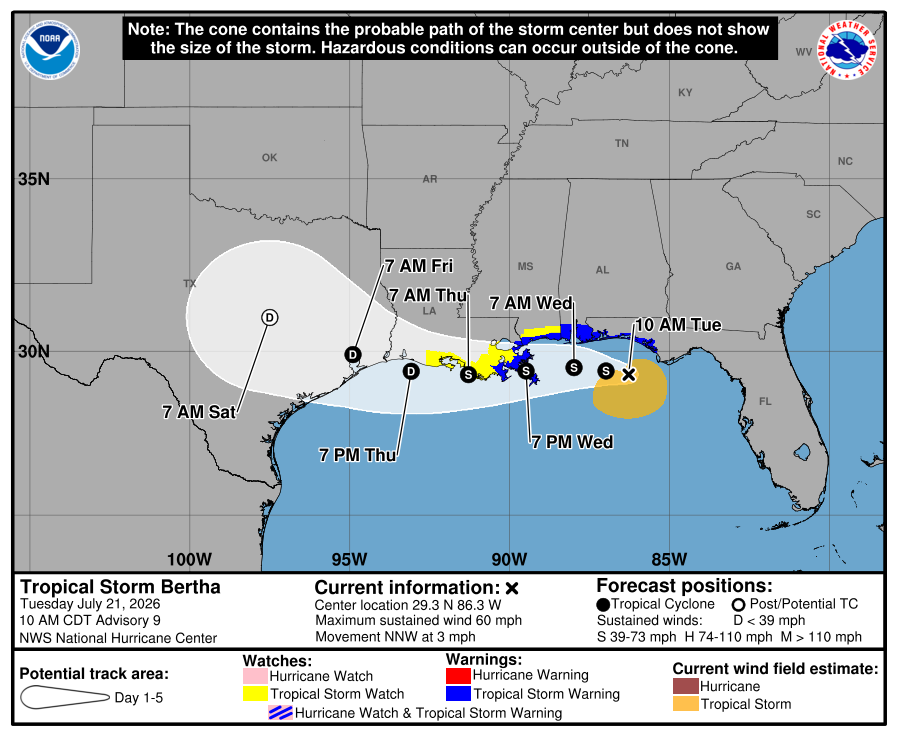
As of Tuesday morning, Tropical Storm Bertha is forecast to potentially make landfall along the coasts of Mississippi and Louisiana, according to theNational Hurricane Center. So far, the storm has reached a maximum sustained wind of 60 mph and is slowly moving northwest at 5 mph.
Justin Gonzalez, a forecaster for the National Weather Service Houston/Galveston Office, said if the storm continues on its currently projected path, several factors are expected to limit the system's organization before it reaches Texas.
"We expect a pretty hostile environment for Bertha due to increasing dry air, increasing wind shear, and also land interaction with southern portions of Louisiana, which is definitely going to, or will likely, hamper Bertha's further intensity," Gonzalez said.
These factors mean Bertha has the potential to be downgraded before it reaches the Texas coast.
"According to the latest guidance from the National Hurricane Center, we're likely looking at possibly a depression by the time it makes it to Southeast Texas," Gonzalez said. "Regardless of the exact state of Bertha, according to the current forecast, we're looking at impacts [to Texas] probably around Friday evening."
At 7 p.m. Monday, the National Hurricane Center officially upgraded the storm from a tropical disturbance to Tropical Storm Bertha. It is the second tropical storm this hurricane season after Tropical Storm Arthur formed in the western Gulf in mid-June and brought heavy rain and strong winds to coastal areas including Galveston.
Cameron Self, a meteorologist at the National Weather Service’s Houston/Galveston office, said Monday thatweather-monitoring planes from the U.S. Air Force and the National Oceanic and Atmospheric Administration (NOAA) began flying into the system Sunday evening and will continue to monitor it as it makes its way through the Gulf.
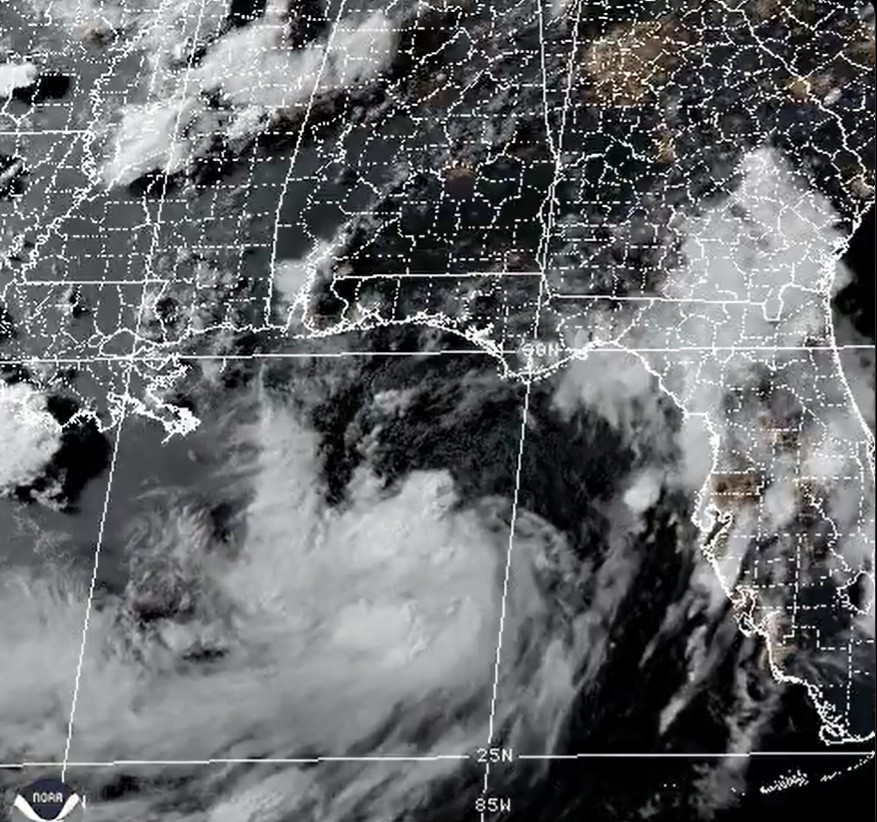
"Even though right now the forecast is not showing significant impacts to our area, any storm in the Gulf is worth keeping tabs on," Self told Houston Public Media on Monday morning. "So we'd recommend checking on the [depression] at least once a day just in case."
The system could bring tropical storm conditions to parts of the Gulf Coast, from the Florida panhandle to southeastern Louisiana, by Monday night or early Tuesday, according to a 10 a.m. advisory from the National Hurricane Center.
Bertha isnot expected to have a major impact on the Texas coast, according to Monday forecasts from the National Weather Service, which said itsforecast was "highly uncertain" beyond Thursday. Projections as of Monday morning show the majority of Southeast Texas, south Louisiana and Mississippi in the potential path of the system.
Self said the forecast will solidify throughout the week.
"Currently it is still in the northeast Gulf, and it's moving very slowly to the northwest," Self said. "We do expect it to turn more toward the west in the general direction of Texas, but the system does have some hurdles it's going to have to get through before it's able to get here."
One of the potential hurdles is if the system makes landfall in Louisiana, Self said.
"If that's the case, that'll take the system from being over the Gulf to over land, which would certainly limit the amount that it could intensify, if not weaken it," he said. "Also there's a lot of shear and dry air that it's dealing with."
However, the system is still expected to strengthen before the end of the week, Self said.
"The conditions are not necessarily so unfavorable to where the system can't strengthen,” he said. “It likely is going to strengthen some ... but right now as it stands, it's not looking like a major impact to Southeast Texas."
Houston Public Media’s Rob Salinas contributed to this story.
Editor’s note: This article was updated on July 21.
Copyright 2026 Houston Public Media News 88.7