

To access the Oak Grove-Johnston Cemetery, visitors must first drive and park over what are likely unmarked burials.
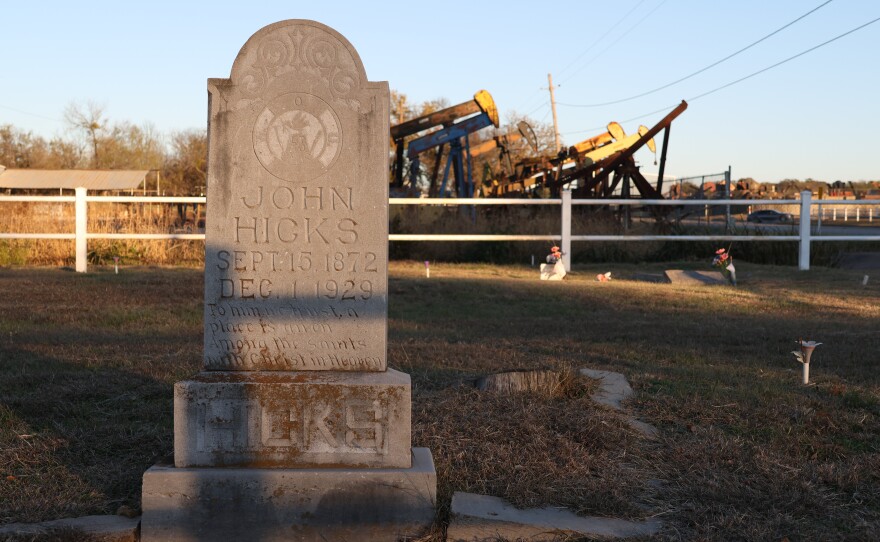
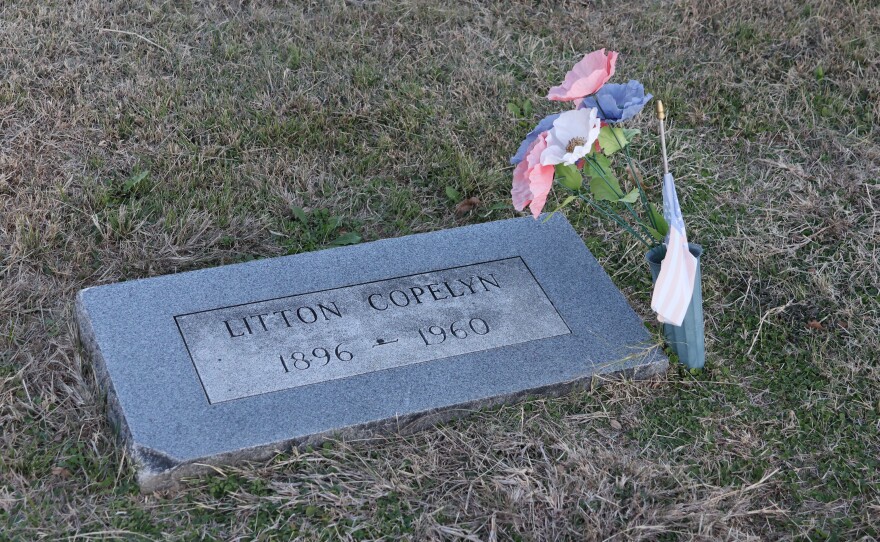
It's a small cemetery in the small city of Graham, about 88 miles northwest of Fort Worth on Highway 380, where obsolete oil pumpjacks loom everywhere like rusty dinosaurs. The 102-year-old historic Black cemetery is neatly maintained and has only eight burial markers sitting sparsely inside its white metal gate.
It didn't always look like this: Just two years ago, the cemetery was even smaller. Large privacy gates encroached on the north and west sides of the property, bushes were overgrown, and heavy machinery was parked over what was once cemetery land.
"It was just debris everywhere," said Rev. Vanessa Sims.
Sims, who lives more than 90 miles away in Denton, first visited the cemetery to pay respects to her infant sister, who had been buried there in 1973. Upset at the state of the cemetery, Sims decided she would do something about it.
Her efforts to restore the cemetery would eventually put her at odds with Young County, and spark a First Amendment fight.
Sims' journey is not unprecedented – Black cemeteries across the country, particularly in the South, have been neglected, leading to the loss of local Black history.
But the cemetery's name itself, Oak Grove-Johnston, was not its original name, and the name is exactly where Rev. Sims journey with the cemetery begins.

A cemetery with two names
Sims grew up with her mother bouncing between different cities before spending third and fourth grade in Graham where her father lived. He died in June 2023.
By that point, Sims had already been a pastor's wife for 30 years, got her master's degree at Southern Methodist University and moved to Denton. Sims returned to Graham for her father's memorial service and said it got her thinking about honoring the dead.
"I was like, you know what? I have a baby sister interred here somewhere. I need to go back and honor her properly because she died as an infant, and that was something that we just didn't talk about as a family, so I felt kind of guilty," Sims said. "So I vowed to go back and honor her."
But when she searched for her sister – Marie Ann East – on the Find a Grave website, Sims found East was listed as being buried in two cemeteries: The Oak Grove Cemetery, which is the larger cemetery on the other side of the highway, and the William P. Johnston Cemetery.
"How can a person be listed in two different cemeteries?" Sims said. "That kind of started the research."
Sims began calling around to figure out who owned the cemetery. She called the Young County Central Appraisal District, the City of Graham, the cemetery superintendent, the local school district and Young County directly. Nobody seemed to know who owned the land.
All she had to go off was the Young County CAD website, which listed the owner as "Colored School and Cemetery." Sensing something was off, Sims contacted the Texas Historical Commission. They told her they had an Oak Grove Cemetery, but no William P. Johnston.
Eventually a representative for the historical commission informed her it would be best if she took efforts to protect it. Sims took that to mean it was time to start documenting things and make a physical visit to the cemetery.
"In order for me to advocate and find out, you know, where the actual cemetery is, I need to actually make the visit," she said.
When she arrived on Aug. 2, 2023, she described the cemetery as "manicured" in the front, but overall in disrepair. Photos Sims took that day show the front of the property was mowed, but the back of the cemetery was overgrown, and one headstone belonging to Phil Smith – who died in 1931 – was covered in a green growth. Six loose headstones had been lined up along the fence.


Sims would finally get a break a couple weeks later when the county discovered it owned the deed – and efforts to clean the property began shortly after. With the ownership now known, Sims wanted to secure a Historic Texas Cemetery Designation for the land. But there was an issue: She needed an official survey. She said the county said it did not have funding to do it, so she funded it herself with the help of friends.
By January 2024, Sims had secured the survey, which would help get the historic designation and allow an archaeologist to examine the area.
County Judge Edwin "Win" Graham IV reached out to Tamra Walter, an associate professor of archaeology at Texas Tech University, to conduct a study of the property. Meanwhile, Sims applied for the cemetery's historic designation.
The state commission chose the name "Oak Grove Colored - Graham Colored - Johnston Cemetery," preserving the various names the cemetery had been referred to on death certificates. The decision would be the seed for conflict later on.
Archaeological breakthroughs
Walter and her team of graduate students began studying the site in March 2024, which resulted in a watershed of discoveries and established a history of the property. Their study, titled "A Place Among the Saints," connects the cemetery's history to the struggles of the establishment of the Black community in Graham.
The cemetery was built in 1923 when Addie Graham – wife of Edwin Graham, who co-founded the town, and great-great-grandmother to the current county judge – donated the land to the Colored Methodist Church "solely as a burying ground for colored people," according to the property deed. The church building was located on the adjacent property to the west, which Addie Graham had also donated in 1921.
The church was burned down in 1921 shortly after its construction and again in 1925, but that time it wasn't fully destroyed.
"While the cause of both fires was undetermined, the practice of burning Black churches was a common intimidation tactic employed by White supremacist groups including the Ku Klux Klan particularly in rural areas of the south during this time," according to the archaeology report.
The church would eventually move from the area, and the church property would end up in the hands of the Graham Independent School District. The district then sold the church property and the cemetery land to the city just before the expansion of Highway 380 in 1971.
"Both deeds related to the property raised questions over the possession of the cemetery, but the county has since affirmed their ownership," according to the report.
The church property ended up being sold to private owners who, intentionally or not, began encroaching on the cemetery property.
Walter told KERA the history of ownership of the years is "murky."
"I can't really tell you that story very well," she said. "But for certain, something happened that allowed people to own part of the cemetery with potential graves underneath it."

The team also discovered another, unexpected way the cemetery had been encroached upon — Highway 380, once 7th Street, was likely expanded over the cemetery in the 1970s. After reviewing aerial photography and the original deed measurements, the team determined the actual southern boundary of the cemetery extended to the middle of the current highway.
"Most distressing about this realization, is the real possibility that burials are under the actual roadway," according to the report. The Texas Department of Transportation did not respond to a request for an interview with KERA.
That means the survey commissioned by Sims was likely not accurate because it didn't take this into account, according to the report.
The encroachment by the highway and adjacent property is rooted in the cemetery's history of segregation, Walter said.
"A lot of these [graves] didn't have markers and you have members of the community that left and weren't there to take care of the cemetery, so neglect was certainly a contributing factor and also racial discrimination," she said. "This is a cemetery that was opened up during Jim Crow and was used during segregation, so you have all of those things that contributed to the vanishing of this cemetery."
The current lack of burial markers can be explained by the cemetery using more affordable metal markers, according to the report. Over time these markers were pushed down and buried by the dirt — likely due to lawn mowing.
During the team's research, the surrounding privacy walls put up by previous owners were removed and the team was able to find graves outside the fence line.
The team identified 41 graves, but concluded there is a "high probability that more graves are present."


Many of the team's findings would be backed by a Ground Penetrating Radar study in August 2025 that found burials not only likely existed outside the fence line, but also on the property to the west where the church was. That land is now owned by the City of Graham and has been converted into a parking area for visitors.

Two families, one cemetery
While major progress on the cemetery was underway in 2024, Sims began to grow frustrated with Judge Graham. She said things changed after he allegedly told Sims her role in the cemetery was over. Though Graham later apologized, the moment stuck with her, she said.
The county then placed picnic tables in the cemetery, which Sims viewed as disrespectful. They were removed after she raised her concerns.
But the largest sticking point was the name of the cemetery. The county planned to officially name the land the "William P. Johnston Cemetery," after a Black groundskeeper who took care of the property every week – seemingly for free. After he died in 1971, many in the community began referring to the cemetery after him. He's buried in Little Rock, Arkansas, according to the archaeology report.
On April 14, 2025, the Young County Commissioners Court officially named the property the William P. Johnston Cemetery. The county said the name has been used to refer to the property for 54 of its 102 years.
"Over the years, the cemetery operated without an official name and has been referred to by various names, many of which include language that is now considered racist and divisive," according to the county's website.
Sims feels renaming the cemetery is whitewashing history.
"If 'colored' offends you, just say Oak Grove-W. P. Johnston. That allows the people that interred their descendants to find their loved ones, because the death certificates don't say anything about Mr. Johnston," she said. The last confirmed burial was in 1963, so it's unlikely any death certificates refer to the cemetery by Johnston's name.
Other Black community members in Graham feel differently. Jackie Tate, who serves on the William P. Johnston Cemetery Preservation Committee, celebrated the name change in a Facebook post and said the old name should no longer be accepted.
"As a black woman in this community my heart is full," she wrote.
The official naming by the county conflicts with the Historical Texas Cemetery designation Sims had obtained that identifies it as the "Oak Grove Colored - Graham Colored - Johnston Cemetery." It also means the official county name does not match the Texas Historical Commission plaque Sims had been trying to get since the summer of 2024.
She had worked with the Young County Historical Commission Chair John Bullock and Marker Chair Kent Pettus to get the marker through the application process, which requires the signature of the historical commission's chairperson.
Sims did eventually get the marker application approved by the state and county historic commissions, and by August 2024, she was fundraising to cover the $950 cost.
The markers are made to order, so it wouldn't be until May 31, 2025, that she received the actual marker, according to emails reviewed by KERA. The final step in the process would have been to coordinate with the county and historical commission to publicly unveil and display the marker.
But in January – not long after Sims purchased the marker – County Judge Edwin Graham ousted Bullock and the rest of the historical commission over disagreements with its election process, according to the local newspaper, the Graham Leader.

The historical commission appointed in January hasn't moved to install the marker, despite Sims having it since May.
Carter Pettit, a current member of the commission, told KERA there is concern about the name of the cemetery on the marker.
"The Texas Historical Commission does not always do follow up research when somebody sends in a request for a plaque," he said. "So the accuracy of that plaque is in question, and it has to do with, you know, it's simply not being called the William P. Johnson Cemetery."
Also at the April 14 meeting, commissioners passed six rules alongside the new name for the cemetery – rules Sims said limited her freedom of speech.
"William P. Johnston Cemetery shall be treated with the utmost respect," according to the fifth rule. "Absolutely no racist, offensive, or derogatory terms or phrases shall be used in any form concerning the cemetery, whether in writing, speech, signage, or any other medium. Any violation of this provision may result in legal action and permanent prohibition from the site."
Sims said she feared the rule would prevent her from referring to the cemetery as the Oak Grove Colored Cemetery. That's when she reached out to the First Amendment Clinic in SMU's Dedman School of Law. Peter Steffensen, assistant director of the clinic, took up the case and emailed the county about their concerns.
"Judge Graham has effectively said that they do not necessarily intend to police the rules in those ways, but part of the problem is the simple fact that these rules are on the books and that they suggest there are legal punishments for speech," Steffensen told KERA.
The rules were amended to remove any reference to a ban on offensive language, but Steffensen still feels the they could still violate Sims freedom of speech.
"Does that cut out a decent amount of the problematic language from the original rules? Yes," Steffensen said. But the rules still lay out ways a person could be banned from the cemetery for not treating the cemetery with "the utmost respect," he said.

Honoring history
While there's still much work to be done at the cemetery, and the issue of the historical marker remains unresolved, Sims is able to find some peace in one thing: She believes she may have found her baby sister's final resting place.
In February 2024 Sims organized a memorial service and balloon release at the cemetery to honor her dead relatives.
"All of my siblings' balloons left the cemetery. My mom's balloon didn't leave the cemetery. It hung up in the tree," she said. "And we're like, that's strange. Maybe Marie said, 'Mom, I'm here. I'm close.'"
A month later, during the archaeology team's survey, they found a shallow burial underneath the same tree.
"My heart just dropped," Sims said.
The coffin had an ornament of a sheep and sun rays, something only put on infant coffins.
"Finally, they unearthed the bones," Sims said. "The torso and everything. It's an infant. Well, I said, 'Marie, is this you?'"
She dug deeper into death records and found people in that area of the cemetery were buried around the same time her sister died, further convincing her it may have been her sister's grave.
Sims said she plans to continue advocating for the cemetery and getting the marker put up.
"The lack of financial resources or challenges do not distract me or discourage me from following up on any nugget of information that might be helpful in being the voice for the voiceless or marginalized people," Sims told KERA in an email. "With faith, I simply move forward knowing that God always provides."
Dylan Duke is KERA's Fall news intern. Got a tip? Email Dylan Duke at dduke@kera.org.
KERA News is made possible through the generosity of our members. If you find this reporting valuable, consider making a tax-deductible gift today. Thank you.
Copyright 2025 KERA News